

Publishing content has been the foundation of SEO strategies for the last 25 years. So when news publishers are questioning how they will survive the next few years, we all need to pay attention to what they do.
Right now, newsrooms are once again trying to negotiate the rapid changes to how information is consumed. Echoing the disruption of the early 1990s, AI is challenging the publishing industry to question how they can survive. And realistically, a lot of brands and publishers will not.
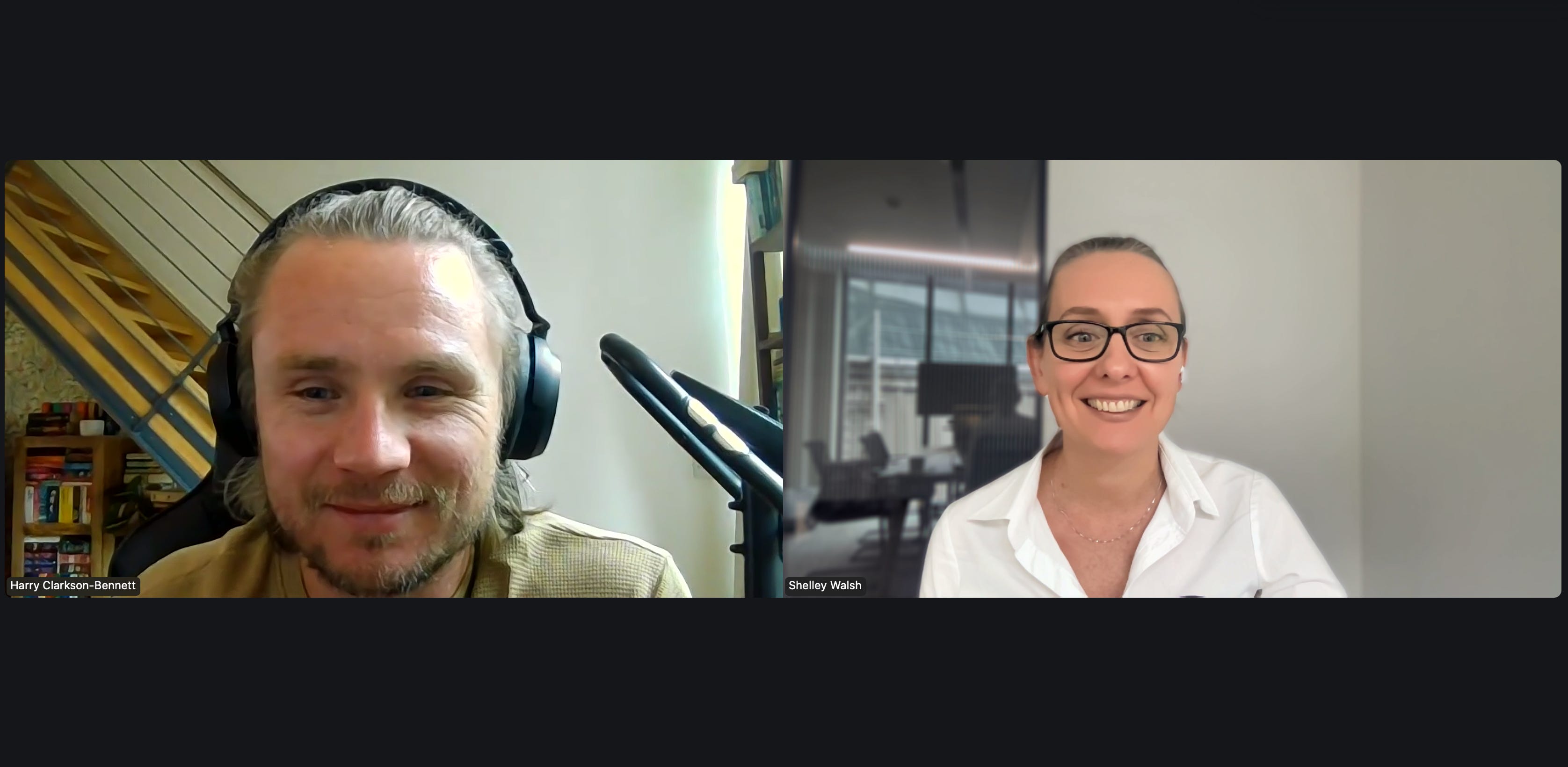
I spoke with Harry Clarkson-Bennett on the latest edition of IMHO. Until very recently, Harry was the SEO Director at The Telegraph, and he’s now a partner at DJB Strategies, advising publishers on AI risk and resilience, publishing, and audience strategy.
Harry has spent four years at The Telegraph watching these traffic shifts up close. What stood out is that the damage has not been a slow, gentle decline. It has come in structural chunks.
The Hits Were Structural, Not Gradual
As familiar as we all are with the depressingly declining graphs on a downward trend, the biggest losses publishers absorbed were not gentle erosion. They were entire sections disappearing more or less overnight.
“When I started, the two or three most significant impacts were parasite SEO updates, which obviously with a manual action can just completely strip out an entire section of a website.”
The damage from these updates was never about losing a quality engaged audience. As Harry put it, “it’s not like the traffic or the audience is necessarily that valuable, it’s just there was a lot of affiliate revenue or advertising revenue associated with some of those projects.”
Then came the update that hit affiliate content directly, including The Telegraph’s own product review operation. “We also had an algorithm update on the affiliate section of our site … [the site was] fairly significantly affected … as were Wirecutter, the Guardian, [and] a few other sites in that space.”
What allows a business to absorb these hits is the revenue model underneath it and this is what Harry believes underlines survival. Resilient revenue beats reach.
“As a subscription business, the Telegraph and the like are pretty resilient, because they do have good, predictable, stable revenue that is so much more valuable than advertising revenue, just on a pound-by-pound basis.”
Historically, there has been a trade off to balance, which means the paywall costs you the open-web engagement signals that feed rankings, and that cost compounds quietly over time. However, as the opportunity of Google traffic reduces, the emphasis on rankings decreases, the importance of the direct audience and subscription increases.
News Is Still Hard For AI. Evergreen Isn’t.
For now, breaking news content is the one area that is resisting AI Overviews and LLMs down to its natural defense, which is the difference between how search engines and machines process and make information visible.
“News is still pretty adept at getting around AI. There are no AI Overviews associated with news until it reaches a certain threshold.”
It’s not certain how long this defense might last and news has other channels taking away its audience to worry about. According to Pew Research, a fifth of U.S. adults now regularly get news on TikTok, up from just 3% in 2020.
News publishers mostly built the volume that sustained their business model through evergreen and commodity content and this is the area that has collapsed.
From my experience, breaking news is a significant incentive for repeat readership in publications, but as younger demographics move to other channels to consume their news, can this deliver revenue to save publishers? The way to survive would be to position in the channels that your next generation of readers is active.
Discover Is Huge. That’s Exactly The Problem.
I’ve spoken to several publishers over the last few years and many are using Google Discover to offset declining organic clicks. And it’s something I am well familiar with as managing editor. But, as John Mueller at Google has warned, the volume of traffic that Google Discover adds to your website is on loan, and someday it can be zero.
Harry’s view aligns with this message that it’s dangerous to over-commit to, but unavoidable to ignore.
“It’s a bad idea to get too committed to Discover, but it’s a huge source of traffic for most publishers now. I suspect if you averaged it out, it’s probably about 70%.”
Traffic is traffic, but not all traffic has real value and Discover might provide the volume, but it is a click baity channel and the traffic it delivers is not necessarily the audience you want.
“It’s not the highest-value thing you can do, but if it’s your biggest way to reach people, which it is for lots of publishers, then you kind of need to take it relatively seriously.”
Forward thinking publishers, he said, are already planning for a world where none of these platforms feel obliged to send them anything.
“Condé Nast recently said they’re planning for Google Zero, and it’s not that they think there will be zero traffic from search. What they’re saying is, what we want to do is create things that, even if there was no traffic from search, would still make sense to our audience business model.”
That instinct holds for any third party, not just Google. As Harry said, “I don’t think it’s a good idea relying on any third party at all for anything.” Echoing John Mueller, it’s all just on loan.
The Individual Now Holds The Power
I believe that an investment in higher quality journalism is a defense against LLMs, as it combines individual unique perspectives along with in-depth research. And we are seeing a rise of journalists building their own audiences on platforms like Substack.
I feel we are seeing the balance of power switch in the rise of the individual.
For years the brand made the journalist. But now with the ease of access to mass distribution, the journalist can easily command and take audiences with them to other platforms and accounts.
A high-profile example is Dave Jorgenson, who built The Washington Post’s TikTok presence to nearly 2 million, then walked and set up his own channel, and was outperforming within months.
I put this theory to Harry and he called it the reverse halo effect.
“There was a point in time where you could work for the Telegraph, the Times, BBC, whatever it would be, and the brand would bring you up. Whereas I think it would be like the reverse halo effect now. What you’d have now is the brand working with the individual. You can leverage their audience, you can leverage the trust that they have with their audience, which brands don’t have.”
Power to the people
Despite Google once telling us that brands were the solution. It seems that individuals are now the solution, or individuals as brands. Underlying this is an erosion of trust in brands and that especially younger audiences trust individuals more.
Harry has plenty of audience experience at the Telegraph.
“Younger audiences trust people, they don’t trust brands. They use news websites in a very different way. They spend 75 to 80% less time on a news website. A 20-something-year-old spends four minutes a day, whereas a 65-, 70-year-old spends like 20 minutes a day on average for these audience groups.”
Of course, news sites can adapt and the Washington Post was certainly doing that when it employed Dave Jorgenson to build their TikTok channel. Unfortunately, they left themselves exposed with over-reliance on one individual’s personality.
I do think that the deluge of homogenized content has brought this on and sadly, marketers and [some] SEOs do ruin things for everyone else! The proliferation of manipulative content has understandably eroded trust in the brand so younger digitally native operators turn to what they see as authentic creators that they can trust.
It is the era of the influencer. I hate that word, but I honestly believe that as the noise grows, and LLMs make content production effectively infinite, the value of somebody with a known, proven, expert level of knowledge and talent and ability will only become more in demand.
Brands will have to accept this trade of talent for insecurity. They have to accept they will build talent and then lose some of it.
“Brands have to be okay with the fact that they will build some, and some will go. They have to be okay with giving people more freedom and creative license to do stuff.”
Content Good Enough To Pay For
If the individual holds the power and organic reach on Google has diminished to almost zero, what does a survivable model look like? Harry’s answer is a paywall, but a smarter one, bundled and habit-forming.
“There’ll be a big rise in the kind of bundle paywall. Everybody’s trying to create habit-forming products.”
Retention counts. “The second they stop coming back to your site every day, their lifetime value starts to drop off fairly quickly.” The New York Times is the model everyone is chasing, and the numbers tell you why.
“They have something like 13 million subscribers altogether, which obviously is high, but only less than 2 million of those are news-only subscribers. So most of their subscription offerings are for games, like puzzles, the Athletic, cooking.”
None of it works without a product worth paying for, and Harry is honest that this is the hard part. As he put it, “you have content that is good enough to pay for. That’s quite difficult to do.” It also means abandoning the metrics that no longer reflect the business.
I asked him about Spur, the collective royalty fund that would pay publishers based on their content’s contribution to LLM output, and whether AI licensing could ever be real money. His view is that it can coexist with the paywall, because the current standoff makes the product worse for everyone.
“The data your models are being trained on is not written, verified, fact-checked to the best of its ability, and is written less by the best-quality people in the industry. So you get a lower-quality product, and companies and newspapers don’t get paid for this content, because people don’t click on it anymore.”
Who’s Still Standing In Five Years
When I asked Harry the survival question directly:
“The publishers that survive are the big classic ones, because they’ve already got a strong audience.”
Those left standing will pair resilient subscription revenue with genuine uniqueness and real audience insight. What he hopes comes out of all this is a return to the things AI can’t easily replicate. He wants publishers to “lean in more to uniqueness and things that make them stand out,” and to “build things that are very resilient to AI.”
The audiences, meanwhile, have already moved to platforms like YouTube, where engagement runs “like 10 times the average publisher,” and they are consuming more than any generation before them, just not where publishers want them to.
“The average teenager, or up to 25 years old, probably consumes the most content of any generation in history, but it’s just not on publisher websites.”
“This is a huge shift, whether we like it or not. So you’ve got to adapt, and if you don’t, I think how long you have left is probably going to depend on how much money you’ve got in the bank.”
As I touched on at the beginning, the industry has seen versions of this before, surviving the move from print to web. Harry agreed, “this industry does have a history of resilience, getting through some of these eras.”
For all the structural upheaval, the fundamentals still hold. There’s always going to be an audience wanting to consume content, and there are always going to be people wanting to produce it. The only real question is who can rebuild the model, before the money in the bank runs out.
Watch the full video interview with Harry Clarkson-Bennett here:
Thank you to Harry Clarkson-Bennett for offering his insights and being my guest on IMHO.
Sign up to Harry’s SubStack Leadership in SEO Substack here